

This post contains affiliate links. If you buy something through these links, I may earn a small commission at no extra cost to you. I only recommend gear I’ve actually used out on the trails and really loved! Read my full disclaimer.
Blackdown Tablelands National Park is on Ghungalu Country. I acknowledge the Traditional Custodians of this area and their deep and ongoing connection to Country, and pay my respects to their Elders past and present.
Blackdown Tableland National Park is a relatively small national park in central Queensland but it delivers a whole lot more than what you might expect.
Even though the weather was a bit crummy over the two days we spent here, there’s enough unexpected beauty to delight (almost) anybody. It makes an excellent addition to a wider road trip through the Sandstone Belt region.
To get there, you wind your way up a narrow road to a high plateau. Almost like on a platter, you’re presented with a landscape so varied that it feels completely disconnected from the dry, flat Queensland country you just gazed onto from the edge of the plateau. Blackdown Tableland is also the traditional home of the Ghungalu people, and you can see examples of Ghungalu rock art and culture on one of the walks.

BLACKDOWN TABLELAND NATIONAL PARK: TIPS FOR YOUR FIRST VISIT
Ideally, plan at least two days here, especially if you have a 4WD and want to complete the 4WD-only scenic drive. We managed to squeeze almost everything into two days but if you prefer to take things a bit more leisurely, plan an extra day or so.
GETTING TO BLACKDOWN TABLELAND
Blackdown Tableland National Park is a long way from Brisbane—about 830km or at least a 9-hour drive. Unless you live in Central Queensland, you’ll probably visit Blackdown Tableland as part of a longer road trip.
From Rockhampton, it’s about 180km inland along the Capricorn Highway. If you’re coming from the west, Emerald is roughly 110km away.
Coming from the coast along Capricorn Highway, the turnoff onto Charlevue Road is about 10km past Dingo, you can’t really miss it. Signage to the park is excellent and there really is only one road once you turn off from the Capricorn Highway.

The road up the plateau is narrow and steep. While it is completely sealed, it’s unsuitable for large motorhomes or caravans as they may struggle to get around the switchbacks.
Past the entrance, the road becomes unsealed and is usually 2WD-accessible all the way to the camping area. The scenic loop drive is strictly 4WD-only.
BEST TIME TO VISIT
Blackdown Tableland was the first stop on one of our winter Queensland road trips, and not surprisingly, the weather was on the colder side.
In winter, expect daytime maximums of 15–20°C, and below 10°C nights since you are high up. Bring warm clothes if visiting in the colder months of the year.
Because the plateau creates its own micro-climate, we found ourselves camping in fog, mud and intermittent drizzle. It somehow added to the atmosphere though it’s equally spectacular on a clear, blue sky day.

If you want to avoid the winter damp but still miss the worst of the heat, spring and autumn are the great for hiking.
Summer can be incredibly steamy even on the plateau (high 20°Cs to low 30°Cs), though it’s generally a few degrees cooler than the scorching plains below. Summer also brings the wet season; while the rain is amazing for the waterfalls, this also leads to track closures and turns the unsealed roads into a sloppy mess.
Whenever you choose to visit, total self-sufficiency is required—bring all your own water as there is no potable supply anywhere in the park.
CAMPING AT BLACKDOWN TABLELAND
There aren’t a lot of options for camping in and around Blackdown Tableland.
The obvious choice is to camp in the national park itself, though if you’re there in winter, the experience might be a rather wet one. There is only one camping area (Munall camping area), which features two loops, with the second loop only suitable for 4WD vehicles.

Camping here is very basic; there are only a couple of drop toilets available and no water supply on the plateau so come prepared. Ensure you’re camping responsibly.
Planning to camp? Read my quick guide to camping at Blackdown Tableland for an overview on site layouts and vehicle restrictions.
OTHER CAMPING OPTIONS
Your other options include staying at the caravan park in Dingo (about 30km away) or even Emerald (about 100km away) if you prefer access to full amenities or don’t want to set up in a slightly slopey and potentially wet camping area.
ESSENTIAL PREP & GEAR FOR BLACKDOWN TABLELAND
Blackdown Tableland isn’t as remote as other national parks in the Sandstone Belt region but you still need to make sure you’re prepared for a trip up the plateau.
Here are a few essential tips for your adventure:
- Supplies & Fuel: Do your main shop in Rockhampton or Emerald if you’re not coming from home or have supplies. Dingo (~30km away) is very small but you can easily get fuel there.
- Vehicle Access: Conventional cars are fine for the road up the plateau but caravans or large camper trailers are not recommended due to narrow switchbacks. The camping area is 2WD-friendly but stick to the first loop. The scenic loop drive is strictly 4WD-only. Check local road conditions at QLD Traffic or parks alerts before heading out though.
- Water: There is no water at Blackdown Tableland. You need to be completely self-sufficient and plan a minimum of 5–7L per person, per day, plus extra for emergencies.
- Emergency Supplies: Even though this place is not as remote as other national parks, help can still be hours away so have a first-aid kit handy and extra food in case you get stuck for a day or two.
Blackdown Tableland Gear Essentials
WALKS & LOOKOUTS AT BLACKDOWN TABLELAND
The varied vegetation and scenery at Blackdown Tableland really surprises you. You’ve got everything from giant ferns, stunningly green mosses, dry eucalypt forest, clear creeks, sandstone gorges, rock pools, waterfalls to sweeping views into the surrounding plains.
Together with the short walks and Ghungalu rock art, the park makes for a very special stop for anyone who likes a mix of nature and cultural history.
GUDDA GUMOO LOOKOUT & GORGE (RAINBOW FALLS)
Gudda Gumoo At a Glance
Gudda Gumoo Gorge is definitely the highlight at Blackdown Tableland.
The track leads into a gorge filled with giant ferns and ends at a rock pool fed by a waterfall. It reflects a shimmering rainbow when the light shines just right against the sandstone walls.

The walk is classified as moderate and yes, you’ll have to head down over 240 (more or less slippery) stairs to get to the base but that’s as difficult as it gets.


If that sounds too daunting, you could just head to the lookout and leave it there. You won’t see much of Rainbow Falls but you do get some views into the lush sandstone gorge and cliffs.

We spent about three hours on this walk, scrambling around rocks and exploring the gorge. It is a really beautiful and tranquil spot.
The Gudda Gumoo area is of a deep cultural significance to the local Aboriginal people so respect the area. You’re not supposed to jump in the rock pool for cultural reasons. But I expect that it might be quite busy in summer as people seek to escape the heat.

MOOK MOOK
Mook Mook At a Glance
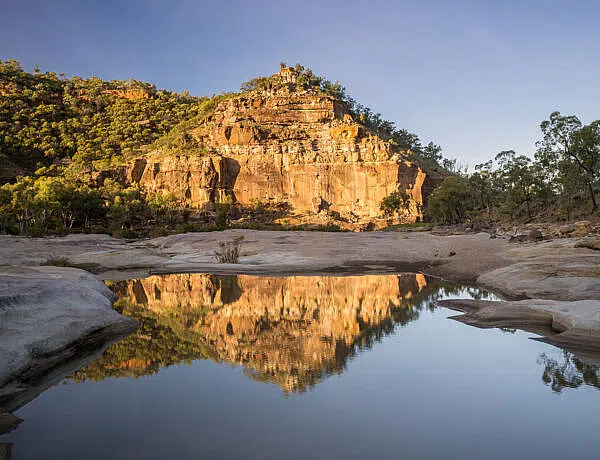
The trail to Mook Mook Lookout starts along Mimosa Creek before crossing it. The track leads to an opening over a sweeping gorge flanked by sheer sandstone cliffs.

I figured Mook Mook would work well for sunrise, and while that’s technically true, the sunrise wasn’t as spectacular as it could have been. The sun creeping over the cliffs and basking them in splendid orange light was pretty stunning though.
GOON GOON DHINA
Goon Goon Dhina At a Glance
Goon Goon Dhina is an easy loop with plenty of interpretative signs along the way.
It starts at the end of the camping area and takes you into a forest full of orange stringybarks, across Mimosa Creek and to the Ghungalu art site. Near the start, you can also see some remnants of an old cattle yard, evidence that this area was used as grazing country around the turn of the century.


Don’t expect too much from the cattle yard though. There are really only a few traditional fence posts left that hint at a time when fencing was done entirely without wire.
Blackdown Tableland doesn’t have the vivid colours of the rock art at Carnarvon Gorge or Mount Moffatt but you can still find some excellent, albeit small, examples of rock art at the Ghungalu art site. Like at any indigenous site, be respectful and don’t touch the artwork.


GOODELA
Goodela At a Glance
Goodela is another easy forest walk but along the escarpment at Blackdown Tableland.
Unfortunately, we ran out of time for doing this walk so I’m not sure whether it’s worth or not.

YADDAMEN DHINA
Yaddamen Dhina At a Glance
Yaddamen Dhina starts from the same day-use area as the Goodela track right at the entrance. It’s only 100m (one-way) so won’t take much time at all. You could also combine this with a picnic at the day-use area where picnic tables and gas bbq are available.

The track leads to a lookout over the escarpment, and though we had hazy views, looking into the plains beyond with cliffs to one side wasn’t too shabby.
4WD-ONLY SCENIC LOOP DRIVE
Beyond the walking tracks and if you’re in a 4WD-vehicle, you could also do the 19km scenic loop drive around part of the national park.

While it’s touted as a scenic route, the drive didn’t quite live up to its promise for us. The track leads mostly through dry forest with almost no views, except for Mitha Boongulla (Charlevue Lookout) about half-way along. By the time we got to the lookout, it was fairly hazy so the views weren’t overly exciting.

While mostly a flat track, there are some sections over large rock slabs and a steep downhill with washouts and rocks. It was mostly high-clearance business and didn’t so much require low-range.


The whole scenic drive probably took us just under a couple of hours so if you’re short on time, definitely give this one a miss.
READY FOR A PLATEAU ADVENTURE?
Blackdown Tableland is an unexpected little gem in Central Queensland.
I didn’t expect Rainbow Waters (Gudda Gumoo) Gorge to be as serene and stunningly beautiful as it was—we really quite enjoyed all the walks. The views around Gudda Gumoo, both from down the gorge at the rock pool and from above, were brilliant and if you’re a bit of rock scrambler, plan more than 1.5 hours to do this walk.
In winter, Blackdown Tableland can be fairly foggy, drizzly and cool, though the sun did try and poke through here and there.
If you’ve been to Blackdown Tableland, let me know in the comments below what you think!
Happy exploring,

Blackdown Tableland Resources
Note: Check the park alerts before you head off—unsealed access tracks like the 4WD Loop Road are highly sensitive to weather and close quickly after wet weather.
SAVE TO PINTEREST



2 Comments
Spophy
4 November 2019 at 2:24 AMHach sieht das da idyllisch aus, die Walks sind bestimmt toll. Und der Kokaboora ist ja soo flauschig x)
Kati
4 November 2019 at 12:32 PMWenn man vom Nebel abgesehen hat, war es wirklich sehr schoen. Und jaaa, die Kookis!!!! <3