

This post contains affiliate links. If you buy something through these links, I may earn a small commission at no extra cost to you. I only recommend gear I’ve actually used out on the trails and really loved! Read my full disclaimer.
Bribie Island is on Kabi Kabi and Joondoburri Country. I acknowledge the Traditional Custodians of this area and their connection to Country, and pay my respects to their Elders past and present.
Bribie Island National Park is a very popular national park within reach of Brisbane and the Sunshine Coast. Access is strictly 4WD-only as you’ll be on sandy tracks right from the park boundary.
Unlike the developed southern end of the island, the northern area is defined by soft-sand beach tracks, beach camping and fascinating WWII remnants.
Here’s what you need to know about the vehicle access, safe beach driving, camping spots and what to explore in this national park.

Note: If you are visiting for the 2WD-accessible beaches, boat ramps or Bongaree amenities, these are outside the National Park boundary.
BRIBIE ISLAND: WHAT TO KNOW BEFORE YOU GO
BRIBIE ISLAND NATIONAL PARK AT A GLANCE
Unlike K’gari or Moreton Island, Bribie is bridge-connected. No ferry needed and for me no awful seasickness, making it a straightforward day out or weekend away from Brisbane or the Sunshine Coast.
GETTING TO BRIBIE ISLAND NATIONAL PARK
Bribie is literally located halfway between Brisbane and the Sunshine Coast.

From the Bruce Highway (M1), take the exit for Bribie Island Road (State Route 85), south of Caboolture. Follow this for about 30km across the Pumicestone Passage Bridge. At the second roundabout, turn onto Goodwin Drive, then follow signs for First Avenue.
Last Supply Stop: Woorim is your last point for groceries and fuel before entering the National Park. North Street continues directly into the National Park boundary, where the bitumen ends and the 4WD tracks begin.
SEASONAL WEATHER
Bribie Island is great all year-round but here are few things to keep in mind for timing your visit:
- Summer: Expect peak humidity, intense midge and mozzie activity and stinger season (bluebottles and more). Avoid weekends if you’re not keen on crowds.
- Winter: Great conditions for beach driving with firmer sand and more predictable tides. Nights are cool so pack accordingly.
- School Holidays: Unless you have little ones in tow, it’s best to avoid Bribie during school holidays. It gets busy.
TECHNICAL ESSENTIALS & GEAR
Exploring Bribie is all about driving the “beach road” along Ocean Beach. It’s an accessible stretch of sand but don’t let that fool you into a false sense of security. The northern tracks can be very soft and unforgiving, especially in hot weather.
Bribie Island Essentials
VEHICLE ACCESS PERMIT
You must hold a valid QPWS vehicle access permit before entering the park. You can buy it online or by phone.
- 1-week permit: $57.40
- Annual permit: $179.20
If you’re keen to explore Bribie for longer and want to come more often, buy an annual one. It works out much cheaper if you come multiple times.
Note: QPWS uses automatic number plate recognition cameras on Bribie Island to check for valid permits when you enter the beach area. The cameras operate 24/7. This also means that you no longer need to display your permit (but you must be able to show a digital copy of it when requested).
4WD BEACH DRIVING: ESSENTIAL TIPS
Bribie’s Ocean Beach is not like Teewah Beach or K’gari further north; the sand here is very soft and unforgiving.
- Vehicle Requirements: A high-clearance 4WD is the only sensible option. While AWD “soft-roaders” occasionally make it, they’re prone to getting bogged—especially in the deeper, sandy sections near the beach entrances and exits. Some experience driving in soft sand definitely doesn’t go amiss on Bribie.
- Airing Down: At the entrance to the national park is a good spot where you let your tyres down. Don’t forget to lock your hubs if you have an older style vehicle where you need to do this manually—we totally forgot that on our first trip to Bribie and voila, got bogged. Slightly embarrassing since this wasn’t our first beach drive. 🙄

- Gentle Acceleration: Beach driving is a bit like driving on ice—the car doesn’t quite behave in the same ways as you may expect. Use low-range, accelerate gently and use consistent momentum while avoiding heavy braking.
- Momentum: At the same time, make sure you enter the beach with enough momentum as beach entrances and exits are usually busy with cars, and full of deep and rutted sand. They’re common ‘get-bogged’ spots.

TIDES & TRAFFIC
Check the Tides: Before planning your trip, take a look at the tide charts to work out the best times to enter Ocean Beach. Avoid driving at high tide as you’ll end up in the more sandy, bumpy banks and cause needless erosion and environmental damage. Or in fact, you may not have any beach at all to drive on.

Traffic Management: As I said above, Bribie is popular. On weekends and during school holidays, treat the beach like a road; stay left, keep your speed at speed limit and be ready to negotiate the beach with oncoming traffic.

7 ACTIVITIES TO EXPLORE THE NATIONAL PARK
Honestly, don’t expect a laundry list of “touristy” attractions here. Instead, come for the beach, the history and to have a few relaxing days camping on the island. Here’s how to actually spend your time.
1. SET UP CAMP
Apart from the 4WDing adventure, Bribie is made for camping and it’s the primary reason to come.

There are three 4WD-accessible camping areas on Bribie: There’s the Ocean Beach side with the other camping areas being on the Pumicestone Passage side.
We stick to the Ocean Beach camping area—just be warned that “ocean views” and “lack of mozzies” are not necessarily the same thing. The Ocean Beach camping area starts roughly 2km from the national park entrance, and then runs for some 20km along the beach.
Need a place to camp? I’ve put together a quick guide to Bribie Island Camping, covering the different zones, where to find the toilets and the reality of the midge situation.
2. LEARN ABOUT FORT BRIBIE: WWII REMNANTS ON BRIBIE ISLAND
For a break from the sand and surf, head to the northern end of Ocean Beach to view the ruins of Fort Bribie. Constructed in 1941, this defence outpost was built in under a year during the height of WWII.

Today, you’ll still find weathered gun emplacements and remains of searchlight buildings buried in the dunes.
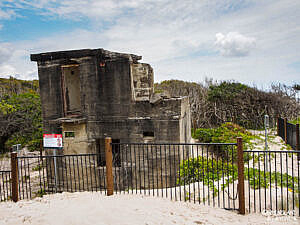
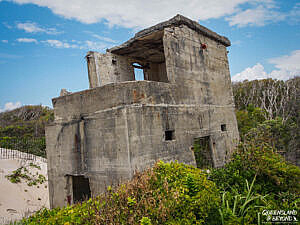
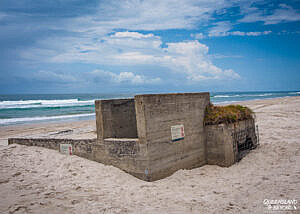
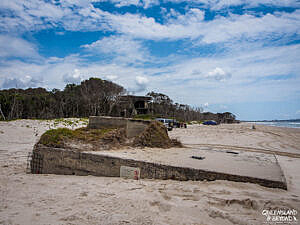
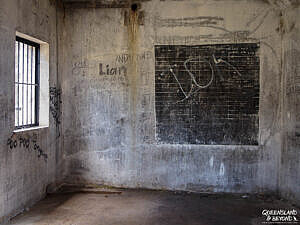
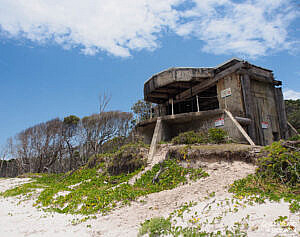
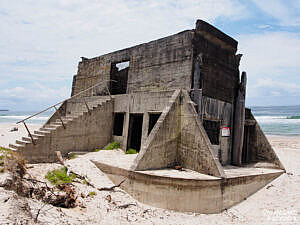
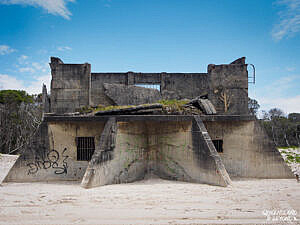
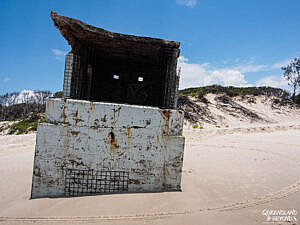
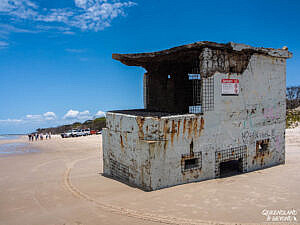
Site Access: Most of the structures are fenced off as they’ve become very unstable due to shifting sand. You can still wander around the perimeter to inspect the remaining bunkers. And to incredulously imagine how much people must have feared a Japanese or German invasion to build a fort here at that time.
Fort Bribie Day-Use Area: You can also access Fort Bribie past the inland day-use area via a 1.9km (one-way) walk if you can’t drive along the beach due to high tide.
Boundary: The Northern Searchlight bunker marks the official end of the vehicle access. Beyond this point, the track is now closed to all access, including walking, due to severe coastal erosion and breakaway sections.
3. SWIM IN THE LAGOONS
Ocean Beach is unpatrolled and often has strong rips and currents—I definitely wouldn’t recommended casual swimming there unless you’re a surfer who really knows the conditions. You don’t want to be swept out to sea.
But it also gets pretty hot here over summer, and your best option for cooling down is to jump into one of the four lagoons.

Like the beaches, these lagoons are constantly changing. With rainfalls they get bigger, and in winter, you might find not much more than a shallow swimming hole to plonk your feet into. When we’ve visited in November, I couldn’t even find Welsby Lagoon (Fourth Lagoon).
When they’re carrying a bit of (inviting) water, the lagoons become very busy. Expect gazebos, awnings and sunshades set up between cars, and crowds that hang out for the day.

Norfolk Creek and Second Lagoon are the standout spots—they’re easily the prettiest. On a Monday in November once, it was just us and the lagoon, but if you’re visiting on a weekend or during school holidays, be prepared for company.
4. KAYAK, SUP OR BOAT THE PUMICESTONE PASSAGE
I’m still not really a water person but I can see why paddling around the Pumicestone Passage is so popular.
While you could easily launch from Caloundra or Golden Beach on the mainland, if you’re camping at Poverty Creek on Bribie, it’s a brilliant way to spend a morning. It’s calm, sheltered and honestly, much better than battling sand flies at Povery Point camp!
5. TAKE A SHORT WALK

Bribie Island doesn’t offer much in terms of hiking—but that’s not its primary charm anyway. You could spend your day walking up and down Ocean Beach but with all the traffic along here, it’s not the most exciting activity.
There are, however, two dedicated short walks on Bribie.
- Bicentennial Bushwalk: An easy 3.8km return track that takes you through bush, shrubs and heathland. It’s supposed to be fantastic for birdwatching, and the best part is you won’t even need a 4WD as you access the walk from sealed Sunderland Drive near town.
- Fort Bribie Walk: If you’re already up near the WWII ruins, there’s an easy (though sandy) 3.8km return walk.
Alternatively, keep it simple and wander along the beach in the morning to watch the sunrise or late afternoon when it’s a bit cooler and the sand stops feeling like a furnace.
6. SPOT SOME WILDLIFE
It’s pretty easy to spot some wildlife in Australia once you leave the urban areas, and Bribie is no exception. If you just hang around camp for a while, you’ll see all sorts of animals cruise past.
Land Creatures: I pretty much saw kangaroos every time I walked to the toilet block. And goannas—they’re everywhere. I don’t think I’ve ever gone camping in Queensland, and not seen one. You’ll also find wallabies keen to hang out in the shrubs just behind the dunes.


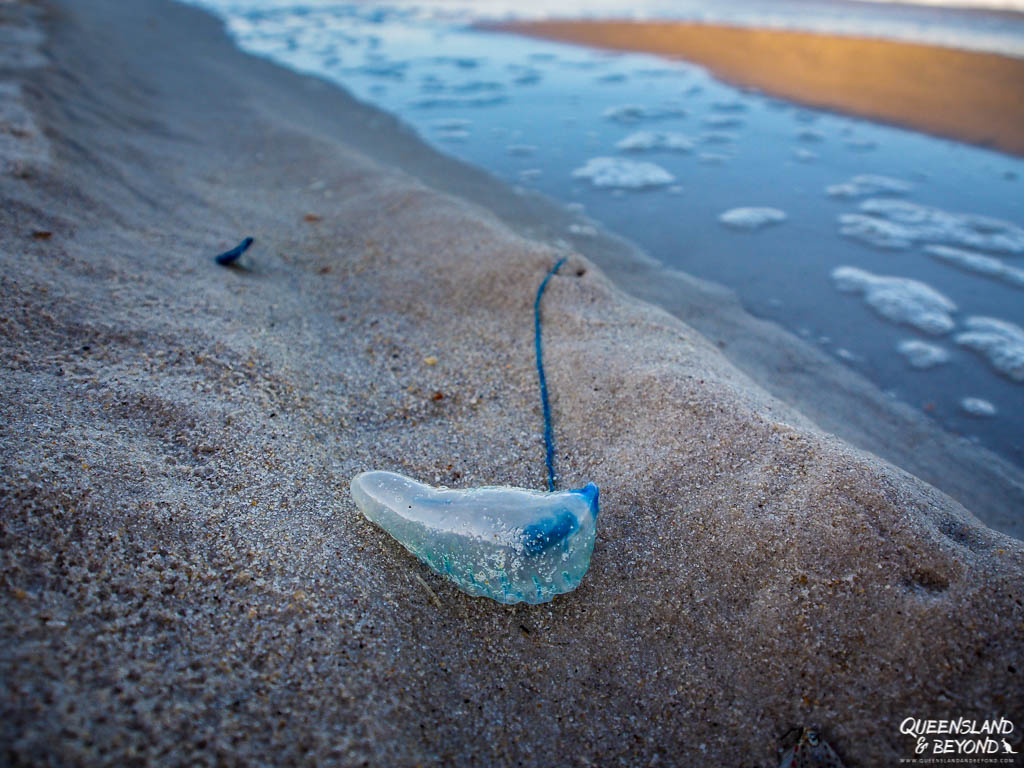
Marine Life & Stingers: On the beach, I’ve seen plenty of blue blubbers washed up. During stinger season (summer), keep an eye out for bluebottles. They can make it as far south as Bribie, and I’m speaking from experience when I say they give a nasty sting that can leave a lasting scar. I’m definitely not keen to repeat that.

Birds of Prey: Just meandering along the beach, we’ve spotted a fair few raptors, including a couple of sea eagles.
7. EXPLORE THE INLAND TRACK
The Bribie Island Northern Access Track basically takes you to Fort Bribie via an inland route with access roads to the camping areas on the Pumicestone Passage side (Gallagher Point and Poverty Creek).
To be honest, it’s not the most exciting drive you could do as most of the inland track is lined by pine plantations. It just gets a little repetitive after a while.

On the other hand, by taking Ocean Beach and then the Northern Access Track (or vice versa) you get that sense of ‘accomplishment’ and feel like you’ve ‘seen’ the whole island and national park.
We’ve pulled into the Poverty Creek campground for a quick picnic lunch. While the campground area is pretty open and doesn’t afford much privacy, there seemed to be far fewer mozzies around than on the Ocean Beach side—total surprise.

SO, IS BRIBIE FOR YOU?
There you have it—seven things to do in the national park.
Beyond that, Bribie is excellent for relaxing, reading, eating, fishing if that’s your jam, and madly flapping your arms around to shoo away the gazillion mozzies that descend on you at every opportunity.
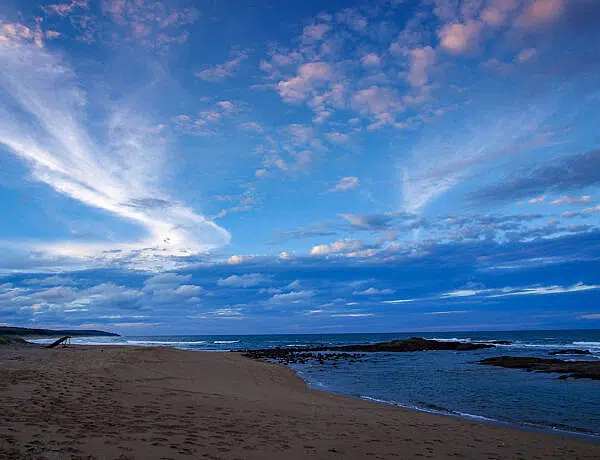
Whilst Ocean Beach on Bribie Island doesn’t wow me like beaches in Western Australia or South Australia have, it’s a nice long stretch of soft white sandy beach, very typical of southeast Queensland.
The Fort Bribie ruins and WWII structures add some interesting historical feature but overall, Bribie might just be the right kind of place for a lazy camping weekend away.
For those ready to level up to longer beach trips, I’ve also covered the essentials for K’gari (Fraser Island)
and the Rainbow Beach coastal tracks.
Happy exploring,

Bribie Island Resources
Note: Check the park alerts before you head off to see if the camping areas and tracks are open.
PIN FOR LATER


No Comments